Essay I / Chispas
By Emanuel Facello · Centauro Kitchen, Mendoza
9 junio, 2026
On the creative process in gastronomy
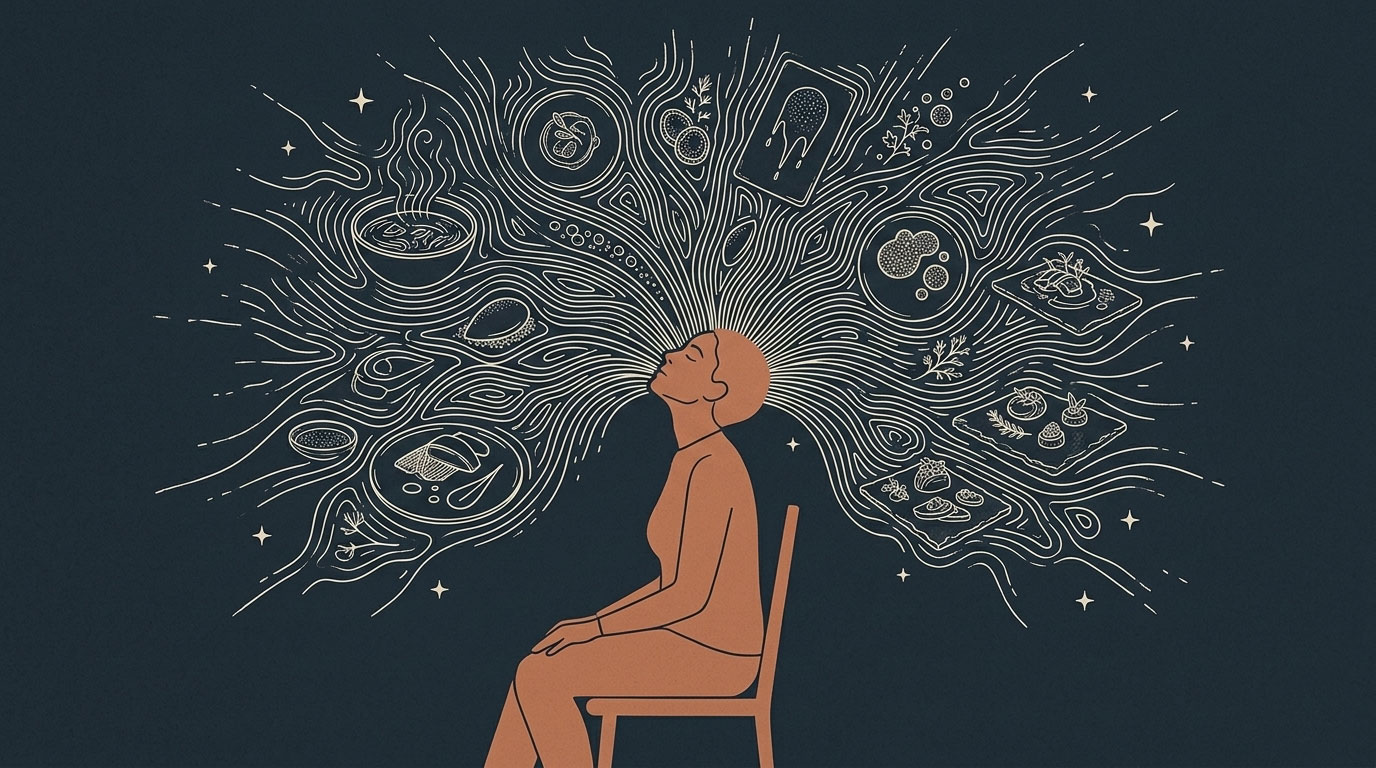
I often ask myself what the purpose of what we do really is. Not in the abstract — I ask myself on a Tuesday at nine at night, looking at a table where someone has just put something in their mouth and can't help but close their eyes for a second. That second is the answer without an answer. That's why I keep asking.
The purpose is to innovate, says the theory. To design a different product. Fine. Now the question that matters: where does that difference lie?
Anyone who has spent two seconds on any creative act knows that all creation is nothing more than a crossing, an intersection of variables that pass through us — what we read or thought we read, what we ate or thought we ate, the advertising signs that change in Borges' story, the chemical composition of the people who make up the team, their moods, always so fragile, so perishable, so fleeting, so elusive, so close, so distant.
A dish is not made by a chef.
It is made by a set of influences that the chef processes without realising, often without being able to name it, without being able to see it, without being able to approach that vertiginous influence with any clarity.
And there lies the crack through which a certain degree of light emerges: in the gastronomic world, there is not much reflection on the creative process. It remains encoded in the minds of chefs, hermetic, impenetrable. Each one finds their own path, discovers a certain intertextuality between technique and memory and product, but rarely does that process produce a reflection on the process itself. As if from the idea to its execution there existed only a chain of emotions that no one names, that travel directly toward their final definition: the dish.
What makes gastronomy different from any other form of creation is that the work never ends.
A musician records an album and releases it to the world. A painter signs the canvas and walks away. In gastronomy, once the menu is complete, it must be performed every single night. It is a theatre where every night you sit an exam. That is exhausting and beautiful at the same time — because it forces you to find improvement within repetition, to seek the spark within the familiar, to have the body learn what the mind designed and then surpass it.
Does that bring us closer to the world of art? Perhaps not entirely. We are still a business that has to reach its own degrees of maturity in the world of business. But innovation does require that those creative processes be rigorous, demanding, full of frustration and joy at the same time. That the projection of what the team creates finds a real connection with the person who comes to sit down.
The idea is a single one: that upon entering the diner's mouth, their mind is flooded with wild sparks. Everything else — the technique, the pairing, the service, the economy of movement — is the path toward that second when someone closes their eyes and is erased for a moment from this world.